
A new air quality monitoring station is now operating in Des Moines, providing ongoing measurements of ultrafine particles and other pollutants near Sea-Tac Airport.
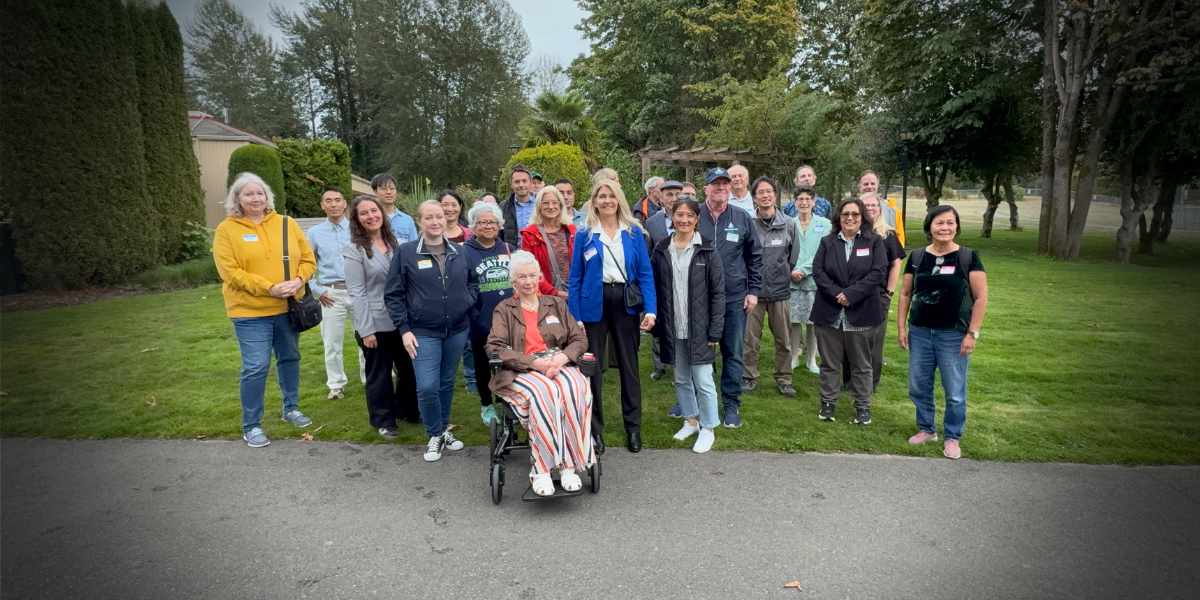
The City of Des Moines joined community members and project partners for a ribbon cutting on Thursday, Sept. 24, celebrating the opening of the site (see video below).
The station will collect local data intended to help researchers and community partners better understand air quality and the potential effects of nearby transportation sources.
Attendees at the ribbon cutting included state Sen. Tina Orwall, state Rep. Mia Gregerson, Des Moines City Manager Katherine Caffrey, Des Moines City Councilmembers JC Harris and Gene Achziger, longtime regional air quality advocate and former Burien City Councilmember Debi Wagner, environmental justice advocate Maria Batayola, Dr. Elena Austin of the University of Washington research team and others. Austin is an assistant professor in the UW Department of Environmental and Occupational Health Sciences and has led research into ultrafine particle pollution in communities near Sea-Tac Airport.
The new station will continuously measure ultrafine particle counts, fine particulate matter known as PM2.5, black carbon, nitrogen dioxide, carbon monoxide and carbon dioxide. Researchers will also track how air quality changes with weather and airport operations.
The project brings together the city, the University of Washington and the Puget Sound Clean Air Agency. It builds on the university’s Mobile Observations of Ultrafine Particles study, which examined pollution around the airport. Funding was provided through Washington’s Climate Commitment Act as part of a 33rd Legislative District local community project.
“There are only a handful of other airports that have air quality monitors that measure ultrafine particles and gases from aviation,” Austin said. She said she knew of no other airport with a comparable arrangement monitoring both directions of airport operations simultaneously.
The project brings together university researchers, state lawmakers, local government officials and community advocates who have sought more information about airport pollution and ways to reduce exposure.
Austin credited state support and directives, along with backing from legislators in the 33rd Legislative District. Speakers also thanked the city of Des Moines for helping make the station possible.
“The City is pleased to partner in bringing this monitoring resource to Des Moines and supporting efforts to provide our community with better information about the air we breathe,” the City of Des Moines said in a statement.
Sen. Orwall has Personal Connection
For state Sen. Tina Orwall, the effort has a personal connection. Orwall said she raised her children in Normandy Park and initially suspected mold at school when her son struggled with asthma. A conversation with a community member prompted her to consider outdoor air quality and learn more about UW research.
That interest helped lead to support for local research through the Move Up study, she said.
Orwall described monitoring as a step toward understanding exposure and identifying ways to reduce it, including filtration and indoor spaces for children.
“It gives me hope that we’re going to all work together to kind of figure out those solutions,” she said.
Councilmember JC Harris: “If you don’t measure it, it doesn’t exist”
Des Moines City Councilmember JC Harris said residents had been seeking better information about aviation impacts for decades. Drawing on his experience in the auto industry, he argued that a lack of measurements should be a reason to investigate.
“If you don’t measure it, it doesn’t exist and people don’t have to care about it,” Harris said, describing an attitude he wanted to challenge.
Debi Wagner, an air quality advocate and former Burien City Councilmember, said the new monitoring effort follows decades of community questions and earlier air quality studies.
“Let’s find out what we’re breathing and then we can make informed decisions about how we should then live,” Wagner said.
Maria Batayola, an environmental justice advocate and chair of the Beacon Hill Council, emphasized the concerns of people of color, immigrants and refugees in South King County. She urged those involved to keep reducing harm at the center of the work.
“Fix the harm, no added harm,” she said.
During a tour after the ribbon cutting, Austin demonstrated the system, which counts particles ranging from 10 nanometers to 1 micrometer across.
Its display shows particle counts minute by minute. Austin said passing aircraft can produce peaks in the smallest particles, although the time between an aircraft passing and its emissions reaching the instrument varies.
Methods developed during the earlier mobile study will help researchers identify aircraft contributions in the new station’s data, she said.
More info in this PDF background document.
Video
Below is video from the event, as filmed/edited by Scott Schaefer:

Recent Comments